狠! 老虎咬傷人 反遭亂棒打死

摘錄自2019年7月28日中時電子報報導

印度北方省(Uttar Pradesh)發生一起暴力攻擊事件,一隻母老虎因咬傷當地村落一名兒童,遭30多位村民圍剿報復,被亂棒打死。當局將提起法律行動,英國《太陽報》(The Sun)報導,印度野生動物保護法(Wild Life Protection Act)規定,一般野生動物犯罪為可判處3至7年有期徒刑以及約新台幣1.1萬元以下罰金,不過這項法律實際上很難落實,印度野生動物保護協會(The Wildlife Protection Society of India,WPSI)的統計數據顯示,至今共紀錄有超過1,144件和老虎相關的訴訟案件,不過僅175人被判有罪。

《印度人報》(The Hindu)報導,鄰近印度北方省「皮利比特老虎保護區」(Pilibhit Tiger Reserve)的一處村落,24日發生3、40位村民合力亂棒打死了一隻母老虎。村民指控,該隻老虎上周咬傷了一名到近郊叢林小解的男童、和9名到場營救的村民,因此引發這起報復行為。

當地官員則稱男童無故擅闖老虎的「自然棲地」。老虎在受襲後9小時不幸喪命,經解剖鑑定,身上有多處骨折,皮膚上也有多處遭鈍器攻擊留下的傷痕,死因為失血過多。

※ 本文與 行政院農業委員會 林務局   合作刊登

本站聲明:網站內容來源環境資訊中心https://e-info.org.tw/,如有侵權,請聯繫我們,我們將及時處理

【搬家相關資訊指南】

在找尋搬家公司嗎?

桃園搬家公司推薦優質、合法立案,讓你安心絕不亂加價!

桃園市搬家公司協助各大專院校學生返鄉打包,詳細優惠專案請洽詢…

搬家前必知的8 件事情!價格、費用、便宜、優質桃園搬家公司哪裡找?

竹南搬家公司頭份搬家公司行情價格一覽表!

法國城市測試抗熱新科技 降低熱島效應

摘錄自2019年8月5日公共電視報導

熱浪發威,法國巴黎今年這個夏天氣溫連創新高,巴黎市長伊達戈計畫要在全市種植35英畝的綠樹與花圃,但要降低都市熱島效應,光靠綠化還不夠。混凝土鋪設而成的人行道,吸熱的能力才驚人。

法國有些城市正在著手測試新的馬路降溫技術,像是特殊塗層可以讓馬路表面降溫大約兩度。

埃法日集團研發主任傑薩洛斯基對此表示:「這相當簡單,表面加了明顯的粒料,你可以感覺出來它沒有那麼暗黑,顏色比較光亮一點。」

土魯斯則是在這個行人徒步區測試路面自行冷卻系統,它會收集雨水,一旦氣溫飆高到攝氏35度的時候,濕氣會蒸發讓地面降溫,和一般柏油路面相比較,溫度差達5度之多。

尼斯也在進行另一套方案,在500平方公尺廣的區域鋪設生態路面。ADPE工程師福傑瑞說:「路面是用碎貝殼而非沙石做成的,也就是說人行道可以呼吸,它會吸收並釋出從上頭降下來的水。」專家建議儘量用鵝卵石、碎石子或是沙來取代瀝青,做為馬路鋪設的材料,一方面它顏色淺可以反射陽光,也較沒有聚熱性的問題。

本站聲明:網站內容來源環境資訊中心https://e-info.org.tw/,如有侵權,請聯繫我們,我們將及時處理

【搬家相關資訊指南】

搬家不受騙不被宰 桃園搬家公司,桃園市搬家公司公開報價讓你比價不吃虧!

竹南搬家公司,頭份搬家公司細心整理裝箱服務,大型家具搬運一次搞定!

助你輕鬆搞定搬家鳥事!

深度解析:氣候變遷、土地劣化影響區域衝突和糧食安全?

《氣候變遷和土地特別報告》深度QA系列2/3 環境資訊中心外電;姜唯 翻譯;林大利 審校;稿源:Carbon Brief

()

報告怎麼看土地沙漠化?

IPCC土地報告將沙漠化定義為「發生在乾旱、半乾旱和乾次濕地區(統稱為乾地)的土地劣化」,由許多因素造成,包括人類活動和氣候自然變化。

因此,報告指出,儘管叫做沙漠化,土地沙漠化不等於「沙漠擴張」,而是「代表發生在乾地的所有形式和程度的土地劣化」。

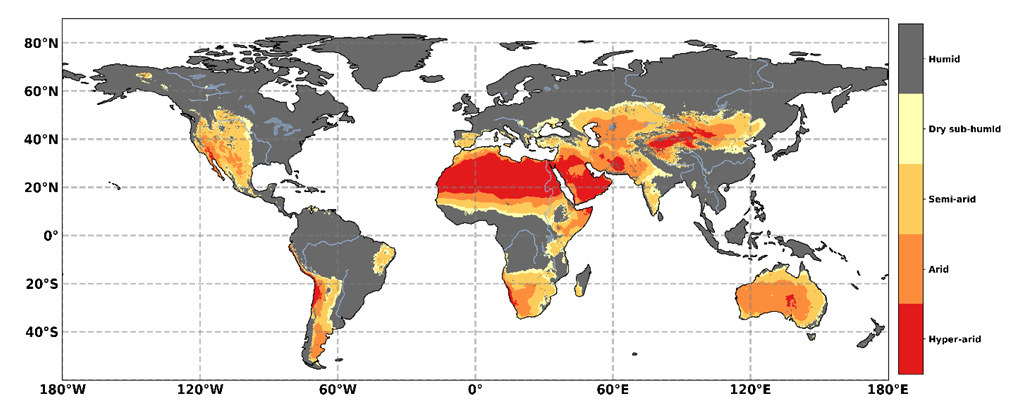
「乾地」一詞包括全世界被定義為乾次濕、半乾旱、乾旱或超乾旱的地區,在下面的IPCC地圖中以黃色、橙色和紅色表示。


乾旱地區的地理分佈,以 為基礎。 AI的分類為:潮濕(灰色陰影)AI> 0.65、乾次濕(黃色)0.50 <AI≤0.65、半乾旱(淺橙色)0.20 <AI≤0.50,乾旱(深橙色)0.05 <AI≤ 0.20、超乾旱(紅色)AI <0.05。資料來源:IPCC土地報告,圖3.1。

全球有30億人口住在乾地,約佔全球人口38%。乾地人口最多的是南亞,其次是撒哈拉以南非洲和拉丁美洲。整體而言,乾地上約90%的人口生活在發展中國家。

乾地人口極易受到沙漠化和氣候變遷的影響,因為他們的生計主要依賴農業,而農業是極易受氣候變遷影響的行業。

驅動沙漠化的因素相當程度能反映土地劣化的原因。然而,由於降雨稀少、規律變化以及土壤肥沃度差,乾地特別容易受到土地劣化的影響。

追蹤全球沙漠化的範圍和程度是很棘手的工作,因為沒有單一的方法可定義或量化之。估算出的數字也會因缺少資訊和/或不可靠的資訊而大不相同。

評估沙漠化程度主要透過三種方法:專家判斷、植被變化的衛星圖像,以及生物物理模型。這三個方法一起使用能提供相對全面性的評估,但沒有一個足以掌握整個情況。

儘管如此,報告指出,過去幾十年來,部分乾地沙漠化範圍和強度增加了。乾地的暖化趨勢是全球平均水準的兩倍。由於乾旱頻率增加導致生長季節土壤水分減少,部分溫帶乾地將轉變為亞熱帶乾地。

報告相當肯定,沙漠化的風險將因氣候變遷而增加。例如,在全球暖化1.5°C、2°C和3°C的「共享社會經濟途徑SSP2」(「中間路線」)下,生活在乾地並面臨缺水壓力、乾旱強度和棲息地劣化等風險的人口分別將達到9.51億、11.5億和12.9億人。

編按:共享社會經濟途徑(Shared Socioeconomic Pathways,SSPs)是IPCC近期所研發的社會經濟情境描述方式,描述五種未來世界在人口、經濟增長、能源需求、社會平等和其他因素方面的差異情境,分別以SSP1~SSP5描述。 。

報告稱,全球暖化將減少乾地作物產量,可能會減少當地的糧食和飼料產量。如果農業生產力沒有提高,食物浪費和損失沒有減少,要滿足不斷增長的糧食需求可能需要將農田擴大到更邊緣的地區。

乾地土壤侵蝕的主因是農田擴張,這可能進一步導致沙漠化。農業生產力下降、糧食價格變化加上極端天氣事件增加可能會加劇部分旱地人口的貧困狀況。「撒哈拉以南非洲和南亞乾地的貧困現象越來越集中,總人口中分別有41%和12%生活在極度貧困中。」

氣候變遷也可能在某些地區刺激遷移。雖然人口外移民短期內可減輕土地壓力,但由於農村勞動力供應減少和/或農村工資增加,可能增加勞動密集型永續土地管理的成本。

與其他形式的劣化一樣,沙漠化會影響氣候變遷,也會受到氣候變遷的影響。下圖總結了其中部分的反饋關係,紅色箭頭表示正面效果,藍色表示負面效果。

例如,植被的減少(圖中間下方)可能使土壤更容易被侵蝕,增加沙塵暴的可能性(右上)。報告稱,這種沙塵的影響會降低當地(從右到左)降水量,進一步加劇沙漠化。


沙漠化影響氣候的主要途徑的。注意:箭頭的顏色表示正(紅色)或負(藍色)效果,或兩者(黑色)。實線箭頭是直接效果,虛線箭頭是間接效果。資料來源:IPCC土地報告,圖3.8。

報告還詳細介紹了一系列「熱點」,以提供沙漠化相關經驗和教訓。這些案例研究包括透過綠牆、入侵植物物種、超乾旱地區的綠洲和流域綜合管理探討土壤侵蝕、植樹造林和森林復育的五個主題。

其中一個案例是撒哈拉大綠牆和薩赫勒倡議。該計畫目的是透過造林和相關計畫,恢復從大西洋沿岸塞內加爾到紅海沿岸厄利垂亞劣化的乾旱地景,減少生物多樣性的喪失並支持當地社群。

然而,雖然部分國家正在實行該倡議,報告警告,如果沒有大量額外資金挹注,很可能難以達成目標。

氣候變遷導致的土地劣化有哪些更廣泛的影響?

,土地劣化已經對全世界人口的生計產生影響,尤其是生活在脆弱和貧困地區的人們。

然而,作者在中明確指出,很難確定氣候變遷在其中扮演的角色:「確立氣候相關的土地劣化對貧困和生計的影響非常不容易,因為牽涉多種社會、政治、文化和經濟因素的相互作用,例如市場、技術、不平等、人口增長,每種因素都與社會生態系統的反應方式相互作用,也形塑著社會生態系統。」

在審視這些問題時,很難將氣候與其他土地劣化因素隔離開來。這個領域的大多數研究都探討了小農的生計問題。由於土壤和降雨變化,人們普遍猜測貧困與氣候變遷之間存在某種潛在關聯,但目前尚缺乏證據。

此外,雖然有研究估計世界上超過2/5的窮人生活在土地劣化地區,但這些資料信度不足,需要更多研究。

報告也指出,氣候變遷經常被視為土地劣化和貧困的風險乘數。此外,報告同意在全世界多個貧窮地區,貧困、土地劣化以及面對與氣候變遷相關極端氣候事件的脆弱性都是相輔相成的。

SPM指出,消除貧困與因應氣候變遷、沙漠化、土地劣化和糧食安全之間存在綜合效應。

更具爭議的是氣候相關土地劣化與遷移和衝突之間的關係。當人們因環境變化而陷入貧困或被剝奪生計時,一種適應方式是遷移到另一個地區,可能是境內或境外。理論上這可能增加遷入地的壓力。例如,研究顯示,與氣候有關的災害可能是導致暴力衝突的一個因素。

雖然氣候引起的遷移與衝突和土地劣化之間的關係還需要更多證據,但SPM指出:「氣候變遷會放大環境導致的境內與跨境遷移,反映遷移有多重因素,也有其適應措施。極端天氣和氣候或緩慢發生的事件可能導致遷移、食物鏈中斷、生計受威脅,並加劇衝突壓力。」

報告舉了一些類似案例。例如,在瓜地馬拉和肯亞,一般認為土壤品質下降是人民往遠方遷徙以尋找收入的主因。

同時,部分學者認為盧安達和蘇丹的衝突與土地劣化有關,也有學者認為氣候變遷是武裝衝突的「弱預測因素」。因此,報告認為這個問題相當程度上尚無定論:「探討氣候變遷-土地劣化主因之一-與衝突的關係的研究有許多相左的結果,而且氣候變遷導致的土地劣化究竟是導致衝突還合作仍然不明。」


報告認為,氣候變遷導致的土地劣化究竟是導致衝突還合作仍然不明。

氣候變遷如何影響糧食安全?

報告的另一個重點是氣候變遷對糧食的影響。SPM表示,氣候變遷已經影響了全世界許多地區的糧食安全。報告說,暖化會直接影響作物生產,進而影響糧食供應。

「可觀察到的氣候變遷已經透過暖化改變降水模式以及更頻繁的極端氣候事件影響糧食安全。氣溫升高正影響高緯度地區的農業生產力,提高了部分作物(玉米、棉花、小麥、甜菜)的產量,而低緯度地區部分作物(玉米、小麥、大麥)的產量則正在下降。

氣候變遷對作物產量的影響因地而異。

在亞洲,包括中國北方等地區,暖化和農業創新等因素導致水稻產量增加。同時,以印度為主的作物產量研究發現,1981年到2009年,暖化使小麥產量減少了5.2%。

近年整個非洲大陸的主要作物如玉米、小麥、高粱和水果的產量都有所下降。喀麥隆的撒哈拉地區營養不良現象日益嚴重,部分原因是氣候變遷,惡劣的氣候條件導致極度乾旱,影響農業生產。

聖嬰現象等氣候自然變化也可能對糧食供應產生深遠影響。發生在2015年末至2016年初的強烈聖嬰現象導致撒哈拉地區區域性降水變化。衣索比亞嚴重乾旱,大面積的作物歉收,超過1000萬人需要糧食援助。


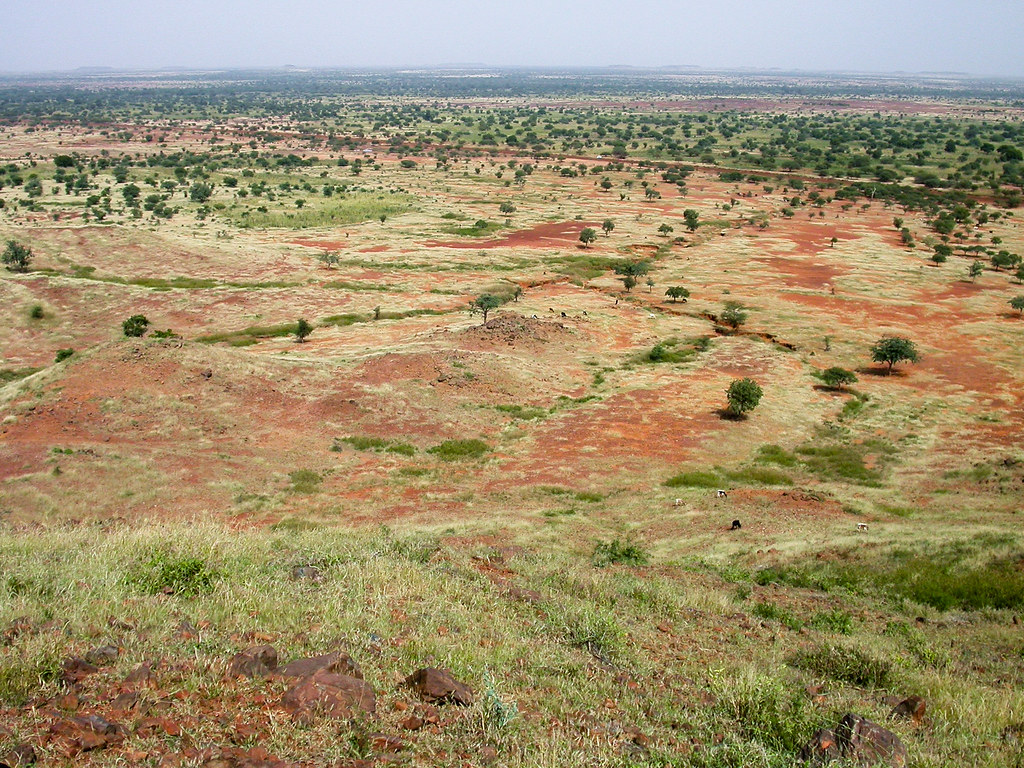
薩赫爾地區的乾地,此處位於非洲北部撒哈拉沙漠和中部蘇丹草原地區之間。 (CC BY-NC-ND 2.0)

報告稱,氣候變遷對糧食產量的影響將在未來幾十年內惡化。

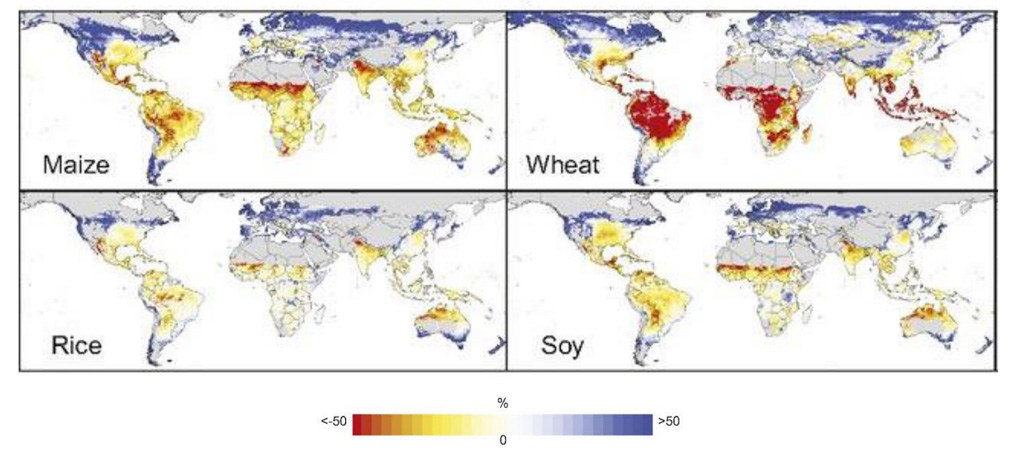
以下地圖摘自第五章第27頁,顯示在嚴重的氣候變遷情境下(RCP8.5,即各國未減碳、CO2濃度達1370ppm的高排放情境),2070~2099年間預期產量與1980~2010年的比較。圖上顯示玉米、小麥、大豆和稻米的變化。在圖中,紅色顯示產量下降50%,而藍色顯示增加50%。

值得注意的是,此預測納入了二氧化碳施肥效應和氮含量壓力的潛在影響。


在嚴重氣候變遷情境(RCP8.5)下,2070~2099年間,玉米、小麥、水稻和大豆產量中位數與1980~2010年的比較。紅色表示產量下降50%,藍色表示增加50%,灰色表示未種植作物的區域。資料來源:IPCC土地報告,圖5.4。

該地圖顯示,如果未來氣候變遷非常嚴重,南美洲和撒哈拉以南非洲部分地區可能會發生嚴重的小麥減產。

除了影響產量外,氣候變遷還可能改變糧食品質。SPM指出,大氣中二氧化碳濃度升高會降低作物的營養成分。報告稱,可能受二氧化碳含量上升影響的營養成分包括蛋白質和鋅。

氣候變遷影響糧食的另一種方式是增加病蟲害。報告發現,有有力證據可證實氣候變遷已經影響了病蟲害的發生。

未來的氣候變遷也可能影響畜牧業生產。沙漠化可能影響牛隻的飼養,熱浪的增加可能直接影響動物的發病率、死亡率和痛苦。

報告稱,糧食供應的變化可能透過改變食品價格影響糧食取得和穩定性。

由於氣候變遷,2050年穀物價格可能會上漲1-29%,導致糧食價格上漲、糧食危機和飢餓風險增加。糧食價格上漲尤其威脅著全世界的窮人。「減產會透過減少高營養作物供應和適應性行為來影響窮人的營養攝取,適應性行為指的是改吃韌性較強但是營養價值較低的糧食……在富裕國家,貧窮通常與高熱量但低營養成分有關,如不良飲食、肥胖、過重和其他相關疾病。」


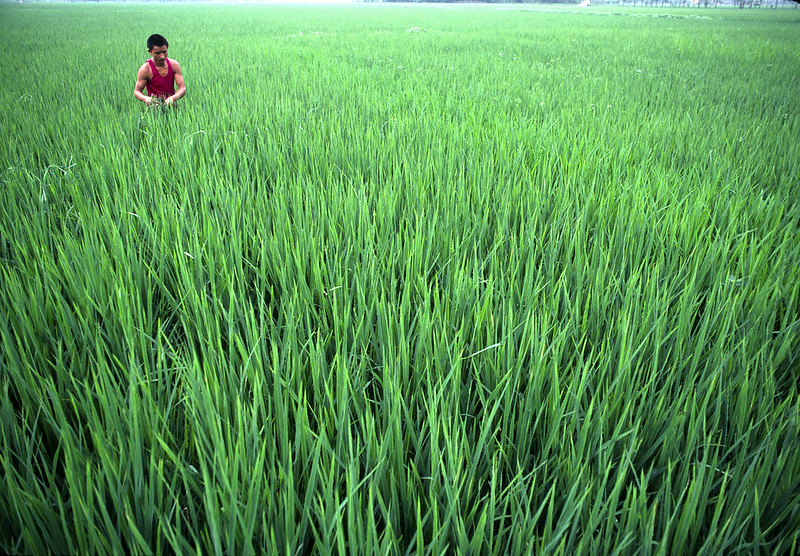
成都的稻田。 (CC BY-NC-ND 2.0)

社會經濟變化對未來土地劣化有多大影響?

報告強調,世界各地的社會經濟變化會決定地球的未來,且預測往往顯示,社經變化對土地利用模式的影響大於氣候變遷。

氣候變遷不僅導致氣溫上升,還會影響人類的消費模式、土地管理和人口變化。SPM中簡要描述:「對糧食、飼料和水的需求增加、資源密集型消費和生產需求增加、農業產量技術進步有限的途徑,導致乾地水資源短缺、土地劣化和糧食不安全的風險增加。」

這裡的「途徑」指的是IPCC報告中的「共享社會經濟途徑」(SSPs),用來瞭解全球社會、人口統計學和經濟學的變化將如何與氣候變遷相互作用。

SSP共有五個,土地報告主要關注前三個,每個都提供了截然不同的結果。(去年明每種情境的含義;也可參閱台大風險社會與政策研究中心)

SSP1的特點是人口增長率低,本世紀末地球上只有70億人口。高收入,整體不平等減少,有效率的土地利用,以及較少的肉類消費和糧食浪費。

SSP2是過去消費和技術進步趨勢的延續,中等人口增長,2100年達到90億。

SSP3的人口幾乎是SSP1的兩倍,2100年為130億。此途徑的特點是低收入、資源密集型消費模式、貿易壁壘和技術變革速度緩慢。

這三個社經途徑以及相對的人口變化、消費模式和其他因素的變化,對未來的土地使用方式差異很大。

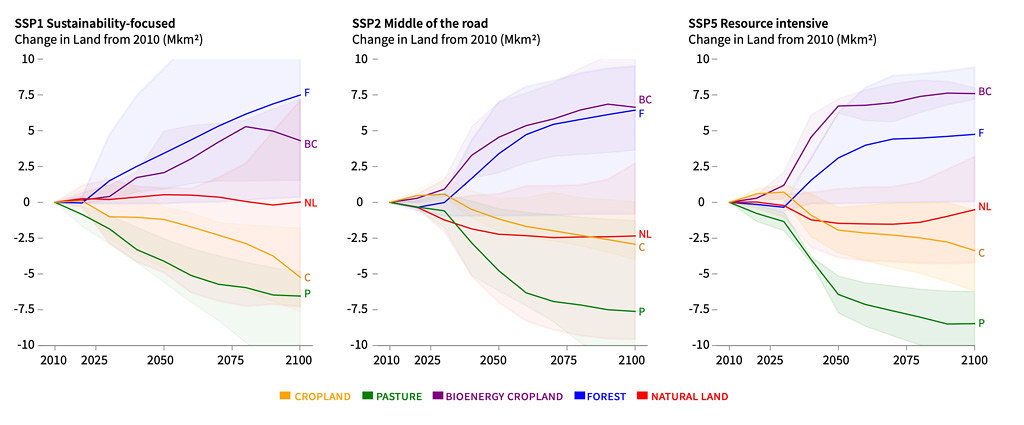
下圖顯示21世紀地球表面用於森林(藍線和陰影區域)、生質能源作物(紫色)、自然土地(紅色)、農田(黃色)、牧場(綠色)與2010年相比的增加(正數)和減少(負數)。

從左到右,每個圖表顯示本世紀末暖化限制在1.5C的情況下土地利用將如何變化。最左邊的圖表顯示了SSP1,中間是SSP2,右側是SSP5(資源密集、依賴化石燃料的途徑)。


升溫1.5°C的情況下,與2010年相比,用於耕地(黃色)、牧場(綠色)、生質能作物(紫色)、森林(藍色)和自然土地(紅色)的變化。左:SSP1。中間:SSP2,右:SSP5。資料來源:IPCC土地報告,SPM4A圖。

不同社經途徑下不同的土地利用優先順序變化,將反過來影響溫度上升導致的風險。

下圖顯示SSP1和SSP35這兩種截然不同的途徑,會如何影響與氣候相關的風險。

例如,即使氣溫上升至3°C(依照目前世界各國自主減排承諾落實狀況,將會升溫3°C),SSP1也只會帶來「中等風險」的沙漠化(下圖中最左邊一欄)。

相反地,在SSP3情境下,沙漠化的風險在升溫1.2°C至1.5°C之間就變成「高」,在3°C之下接近「非常高」(左起第二個)。與土地劣化有關的其他風險也是類似的趨勢,例如火災和沿海洪水。


不同社經途徑(SSP1和SSP3)如何影響氣候相關風險。顏色代表影響/風險水準,紫色表示「非常高」的風險和「顯著的不可逆性」,氣候相關的危害和有限的適應能力,白色表示沒有可偵測到和可歸因於氣候變遷的影響。字母表示調查結果的信心水準(「L」代表低,「M」代表中等,「H」代表高)。資料來源:IPCC土地報告,圖SPM.2B。

作物產量變化和糧食供給危機已經被歸因於氣候變遷,但這些風險再次受到某些社經情境的影響。

一項研究估計,SSP1之下,升溫2.5°C時,將有1億人面臨氣候相關飢餓風險,而SSP3之下,升溫3°C時,將使超過8億人受影響。

作者的結論是,必須「以整體性的方式」解決貧困、土地劣化和排放的惡性循環,以產生如SSP1的永續發展,並避免最壞的後果。(系列專文2/3,未完待續)

In-depth Q&A: The IPCC’s special report on climate change and land (2/3) by Carbon Brief

What does the report say about desertification?

The IPCC land report defines desertification as “land degradation in arid, semi-arid, and dry sub-humid areas, collectively known as drylands, resulting from many factors, including human activities and climatic variations”.

Therefore, despite its name, desertification is not “equated to desert expansion”, the report notes, but “represents all forms and levels of land degradation occurring in drylands”.

The term “drylands” encompasses parts of the world that are defined as dry sub-humid, semi-arid, arid or hyper-arid – indicated by the yellow, orange and red shading in the IPCC map below.

(For a detailed primer on desertification, published an explainer earlier this week.)

Geographical distribution of drylands, based on the (AI). The classification of AI is: Humid (grey shading) AI > 0.65, dry sub-humid (yellow) 0.50 < AI ≤ 0.65, semi-arid (light orange) 0.20 < AI ≤ 0.50, arid (dark orange) 0.05 < AI ≤ 0.20, and hyper-arid (red) AI < 0.05. Source: Figure 3.1 from the .

Drylands are home to approximately 38% of the global population, the report says – around three billion people. The largest number of people living in drylands are found in South Asia, followed by sub-Saharan Africa and Latin America. Overall, “about 90% of the population in drylands live in developing countries”, the report notes.

Dryland populations are “highly vulnerable to desertification and climate change”, the report notes, because their livelihoods “are predominantly dependent on agriculture; one of the sectors most susceptible to climate change”.

The drivers of desertification mirror those of land degradation more widely – – however, drylands are particularly vulnerable to land degradation because of scarce and variable rainfall as well as poor soil fertility.

Tracking the global extent and severity of desertification is particularly tricky because there is no single way to define or quantify it. Estimates also tend to “vary greatly due to missing and/or unreliable information”, the report says.

There are three main three methods of assessing the extent of desertification – expert judgement, satellite images of vegetation change and biophysical models. Together they “provide a relatively holistic assessment”, the report says, “but none on its own captures the whole picture”.

Nonetheless, “there is high confidence that the range and intensity of desertification has increased in some dryland areas over the past several decades”, the report says. “Warming trends over drylands are twice the global average,” it adds, and “some temperate drylands are projected to convert to subtropical drylands as a result of an increased drought frequency causing reduced soil moisture availability in the growing season”.

The report also has “high confidence” that “risks from desertification are projected to increase due to climate change”. For example, under the (“Middle of the Road”) at 1.5C, 2C and 3C of global warming, the population living in drylands and exposed to risks such as water stress, drought intensity and habitat degradation is projected to reach 951 million, 1.15 billion and 1.29 billion people, respectively.

Global warming “is projected to reduce crop yields across dryland areas, potentially reducing local production of food and feed”, the report says. Without concomitant increases in agricultural productivity and reductions in food waste and loss, meeting growing food demand will thus likely require expansion of farmland into ever-more marginal areas.

As a primary driver of soil erosion in drylands is cropland expansion, this risks further contributing to desertification, the report warns. It adds that the combination of agricultural productivity declines, changes in food prices and increases in extreme weather events is likely to exacerbate poverty for some dryland populations.

“There is an increasing concentration of poverty in the dryland areas of sub-Saharan Africa and South Asia,” the report notes, “where 41% and 12% of the total populations live in extreme poverty, respectively.”

Climate change is also likely to “provide an added incentive ” in some places, the report says. And while outward migration could reduce pressure on the land in the short-term, “this can increase the costs of labour-intensive SLM [sustainable land management] practices due to lower availability of rural agricultural labour and/or higher rural wages”.

As with other forms of degradation, desertification can both influence climate change and be influenced by it. The figure below summarises some of these feedbacks, with positive effects shown by red arrows and negative effects by blue.

For example, a decline in vegetation (below centre in the figure) can leave the soil more at risk of erosion, increasing the likelihood of sand and dust storms (top right). The effects of this dust “would tend to decrease precipitation” in the local climate (top, right to left), the report says, thus further reinforcing desertification.

Illustration of the main pathways through which desertification can feedback on climate. Note: The colour of the arrows indicate a positive (red) or negative (blue) effect, or both (black). Solid arrows are direct while dashed arrows are indirect. Source: Figure 3.8 from the .

The report also details a series of “hotspots” to “present rich experiences and lessons learnt” on desertification. These case studies cover the five topics of soil erosion, afforestation and reforestation through “green walls”, invasive plant species, oases in hyper-arid areas, and integrated watershed management.

One example given is the . This project aims to “restore Africa’s degraded arid landscapes, reduce the loss of biodiversity and support local communities” through “establishing plantations and neighbouring projects…from Senegal on the Atlantic coast to Eritrea on the Red Sea coast”.

However, although the initiative is underway in several countries, “the achievement of the planned targets is questionable and challenging without significant additional funding”, the report warns.

What are the wider impacts of climate change-driven land degradation?

Research land degradation is already having an impact on the livelihoods of people around the world, particularly those living in vulnerable and poverty-stricken regions.

However, in the authors are clear that it is difficult to identify the fingerprints of climate change in these processes:

“Unravelling the impacts of climate-related land degradation on poverty and livelihoods is highly challenging. This complexity is due to the interplay of multiple social, political, cultural, and economic factors, such as markets, technology, inequality, population growth, each of which interact and shape the ways in which social-ecological systems respond.”

When examining these issues, the report says it has been difficult to isolate climate as a factor from other drivers of land degradation.

Most studies in this area have examined livelihoods of small-scale farmers, and while there is widespread speculation about “potential links” between poverty and climate change due to changes in soil and rainfall, the evidence is currently lacking, it says.

Furthermore, while one study estimated that more than two-fifths of the world’s poor live in degraded areas, the report says there is “low confidence” in such figures and notes a need for more research in this area.

However, the report also states that climate change is “frequently noted as a risk multiplier” for both land degradation and poverty. In addition, it acknowledges that in many of the poorest parts of the world, poverty, land degradation and vulnerability to extreme events linked to climate change all go hand-in-hand.

The SPM notes there are “synergies” between poverty eradication and efforts to tackle climate change, , land degradation and food security.

More contentious is the link between climate-related land degradation and migration and . When people are pushed into poverty or have their livelihoods stripped as a result of changes in their environment, one adaptation option is to move to another area – this can be internally or across borders. In theory, this can then . , for example, that climate-related disasters can be a contributing factor to violent conflict.

While the authors note there is still a need for more evidence about the links between climate-induced migration and conflict due to land degradation, the SPM states:

“Changes in climate can amplify environmentally induced migration both within countries and across borders, reflecting multiple drivers of mobility and available adaptation measures. Extreme weather and climate or slow-onset events may lead to increased displacement, disrupted food chains, threatened livelihoods, and contribute to exacerbated stresses for conflict.”

The main report cites a handful of examples of such processes. For example, in and , declining soil quality has been widely cited as a driver behind migrants heading farther afield to generate income.

Meanwhile, conflicts in both and have been linked by some scholars to land degradation, whereas others have found climate change is a “weak predictor” for armed conflict. As such, the report finds that the evidence from this area is largely inconclusive:

“Studies addressing possible linkages between climate change – a key driver of land degradation – and the risks of conflict have yielded contradictory results and it remains largely unclear whether land degradation resulting from climate change leads to conflict or cooperation.”

How can climate change affect food security?

Another major focus point in the report is the ways in which climate change can affect food.

Climate change has “already affected food security” in many world regions, the SPM says.

Warming is affecting food availability by having a direct impact on crop production, says of the report:

“Observed climate change is already affecting food security through increasing temperatures, changing precipitation patterns, and greater frequency of some extreme events. Increasing temperatures are affecting agricultural productivity in higher latitudes, raising yields of some crops (maize, cotton, wheat, sugar beets), while yields of others (maize, wheat, barley) are declining in lower-latitude regions.”

The current impact of climate change on crop yields varies from region to region, the report notes.

In Asia, some parts, including northern China, have seen rice yield increases as a result of regional warming and other factors, such as agricultural innovation, the report says. Crop yield studies focusing on India, meanwhile, have found that warming cut wheat yields by 5.2% from 1981 to 2009, the report says.

In Africa, yields of staple crops such as maize, wheat, sorghum and fruit, including mangoes, have decreased across the continent “in recent years”, the report says. “The Sahel region of Cameroon has experienced an increasing level of malnutrition, partly due to the impact of climate change since harsh climatic conditions leading to extreme drought have a negative influence on agriculture.”

(To read more about how climate change impacts food around the world, read Carbon Brief’s recent on how traditional dishes could fare if temperatures rise.)

Climate variability can also have a “profound” impact on food availability through phenomena such as El Niño, notes .

For example, this “occurred during late 2015 to early 2016 when a strong El Niño contributed to regional shifts in precipitation in the Sahel region,” the report says. “Significant drought across Ethiopia resulted in widespread crop failure and more than 10 million people in Ethiopia required food aid.”

The impact of climate change on food yields is expected to worsen in coming decades, the report says.

The maps below, taken from page 27 of , shows median yield changes expected in 2070-99, when compared yields from 1980-2010, under a severe climate change scenario (“”). Changes are shown for maize, wheat, soy and rice. On the chart, red shows yield declines of up to 50% while blue shows increases of up to 50%.

It is worth noting that the projections consider the potential impacts of the CO2 fertilisation effect and nitrogen availability stress (both explained in more detail above).

Median yield changes expected for maize, wheat, rice and soy in 2070-99, when compared with yields from 1980-2010, under a severe climate change scenario (RCP8.5). Red shows yield declines of up to 50% while blue shows increases of up to 50%. Grey shows areas where crops are not grown. Source: Figure 5.4 from the .

The map indicates that severe wheat losses could occur in South America and parts of sub-Saharan Africa if future climate change is very high.

As well as affecting yields, climate change could alter food quality, the SPM notes: “Increased atmospheric CO2 levels can lower the of crops.” Nutrients that could be affected by rising CO2 include protein and zinc, the report says.

Another way that climate change affects food is through boosting pests and diseases. The report finds “robust evidence that pests and diseases have already responded to climate change”. It says:

“There is some evidence that exposure will, on average, increase, although there are a few examples where changing stresses may limit the range of a vector [disease carrier].”

Future climate change could also affect livestock production, the report notes. could affect rangelands where cattle are reared, the report says, while increases in heatwaves could have a “direct impact on animal morbidity, mortality and distress”.

Changes to food availability could in turn have an impact on food access and stability via changes to food prices, the report says.

Cereal prices could increase by 1-29% by 2050 as a result of climate change, the SPM says, “leading to higher food prices and increased risk of food insecurity and hunger”.

Higher food prices particularly threaten the world’s poor, the report notes:

“Decreased yields can impact nutrient intake of the poor by decreasing supplies of highly nutritious crops and by promoting adaptive behaviours that may substitute crops that are resilient but less nutritious…In the developed world, poverty is more typically associated with calorifically-dense but nutrient-poor diets, obesity, overweight, and other related diseases.”

The report emphasises that access to food is also highly linked to other land issues, such as desertification, degradation and water availability. To learn more about how these issues are interconnected, read Carbon Brief’s recent guest post on the “”.

How important are socioeconomic changes for future land degradation?

The report emphasises the role that socioeconomic changes around the world will have in determining the planet’s future, noting that projections often show these shifts having a larger impact on land use patterns than climate change itself.

The harm generated by the changing climate will not only result from rising temperatures, but also on how humanity’s consumption patterns, land management and populations shift alongside it, the report says. This is outlined concisely in the SPM:

“Pathways with higher demand for food, feed, and water, more resource intensive consumption and production, and more limited technological improvements in agriculture yields result in higher risks from water scarcity in drylands, land degradation, and food insecurity.”

The “pathways” it refers to are a standard set of “” (SSPs), which are used across the IPCC’s reports to give a sense of how changes in global society, demographics and economics will interact with climate change.

While there are five SSPs in total, the land report mainly focuses on the first three, with each one offering significantly different outcomes. A from last year outlines what each of these scenarios means in more detail.

SSP1 is characterised by low population growth, with just seven billion people on the planet by the end of the century. High incomes, reduced overall inequalities and effective land use regulations are also features of this scenario, as well as less meat consumption and food waste.

Based on a continuation of past trends in consumption and technological progress, SSP2 results in medium population growth, hitting nine billion by 2100.

SSP3 meanwhile sees population nearly double that of SSP1, at 13 billion in 2100. This pathway is characterised by low incomes, resource-intensive consumption patterns, barriers to trade and a slow rate of technological change.

Which of these socioeconomic pathways is followed – and the changes in population, consumption patterns and other factors that result – has a large impact on the way land will be used in future, the report says.

The figure below shows how much more (positive numbers) or less (negative numbers) of the Earth’s surface would be devoted to forest (blue line and shaded area), bioenergy crops (purple), “natural land” (red), cropland (yellow) or pasture (green) through the 21st century, compared with the levels in 2010.

From left to right, each chart shows how land use will change in scenarios limiting warming to 1.5C by the end of the century. The left-most chart shows this for SSP1, with SSP2 in the centre and SSP5 on the right (this is a , fossil-fuel dependent pathway).

Changes, relative to 2010, in the area of land devoted to cropland (yellow), pasture (green), bioenergy crops (purple), forest (blue) and “natural land” (red) in scenarios limiting warming to 1.5C above pre-industrial temperatures. Left: SSP1. Centre: SSP2. Right: SSP5. Source: Figure SPM4A from the .

These changing priorities for land use under each different socioeconomic pathway are expected, in turn, to influence how strongly rising temperatures increase risks, the report says.

These influences are illustrated in the figure below, which shows how two very different pathways – SSP1 and SSP3 – will affect climate-related risk.

For example, SSP1 carries only a “moderate risk” of desertification (leftmost column in the chart below) even if temperatures rise as high as 3C. (This is the increase the world is for given nations’ existing climate commitments.)

In contrast, under the SSP3 scenario, the risk of desertification becomes “high” at between 1.2C and 1.5C of warming, and approaches “very high” below 3C (second from left). There is a similar trend for other risks relating to land degradation, such as fires and coastal flooding.

Figure showing how different socioeconomic pathways (SSP1 and SSP3) will affect climate-related risks. The colours represent levels of impact/risk, with purple meaning very high risks and the presence of “significant irreversibility”, climate-related hazards and limited ability to adapt, and white indicating no impacts that are detectable and attributable to climate change. Letters represent the level of confidence in the findings (with “L” representing low, “M” representing medium and “H” representing high). Source: , Figure SPM. 2b.

The report notes that the greatest number of relevant SSP studies to date consider how food security will be affected as temperatures rise.

Changes in crop yields and accompanying threats to the food supply been attributed to climate change, but again these risks are exacerbated by certain socioeconomic scenarios, it says.

estimated that SSP1 would see 100 million people at risk of climate-related hunger beyond 2.5C, while SSP3 would leave over 800 million people vulnerable by 3C.

The authors conclude that addressing cycles of poverty, land degradation and emissions “in a holistic manner” will be necessary to produce sustainable development of the kind exemplified by SSP1 and to avoid the worst outcomes.

For more information, Table 6.2 in of the report outlines the key challenges faced under different SSPs – including SSP4 and SSP5 – for outcomes including climate change adaptation and mitigation, land degradation and food insecurity.

※ 全文及圖片詳見:()

作者

如果有一件事是重要的,如果能為孩子實現一個願望,那就是人類與大自然和諧共存。

於特有生物研究保育中心服務,小鳥和棲地是主要的研究對象。是龜毛的讀者,認為龜毛是探索世界的美德。

本站聲明:網站內容來源環境資訊中心https://e-info.org.tw/,如有侵權,請聯繫我們,我們將及時處理

【搬家相關資訊指南】

在找尋搬家公司嗎?

桃園搬家公司推薦優質、合法立案,讓你安心絕不亂加價!

桃園市搬家公司協助各大專院校學生返鄉打包,詳細優惠專案請洽詢…

搬家前必知的8 件事情!價格、費用、便宜、優質桃園搬家公司哪裡找?

竹南搬家公司頭份搬家公司行情價格一覽表!

日本擬排福島核污水入太平洋 南韓首當其衝

摘錄自2019年8月14日聯合報報導

管理核污水的東京電力公司表示,福島核電廠將在三年內達核污水儲存上限。而根據韓聯社報導,南韓將積極應對日本將福島核電廠核污水排放太平洋的計畫,核污水放流計畫已引來國際關注。綠色和平組織對此表達憂慮,並在今年稍早一份報告中警告,南韓將會是受核污水影響首當其衝的國家。

南韓外交部發言人金仁澈表示,南韓把國民健康及安全放第一。南韓同時計畫積極要求日本提供放流細節,以及目前的管理系統、核污水棄置細節。

南韓政府自2018年8月意識到日本核污水放流太平洋計畫後,立即要求日本針對核污水處理舉行雙邊和多邊談話。同年10月,南韓致函日本表達其憂慮。不過日本政府一味宣稱,流放核污水計畫仍在商討階段,若計畫確定將會告知國際。

本站聲明:網站內容來源環境資訊中心https://e-info.org.tw/,如有侵權,請聯繫我們,我們將及時處理

【搬家相關資訊指南】

搬家不受騙不被宰 桃園搬家公司,桃園市搬家公司公開報價讓你比價不吃虧!

竹南搬家公司,頭份搬家公司細心整理裝箱服務,大型家具搬運一次搞定!

助你輕鬆搞定搬家鳥事!

美官方氣象機構:2019年7月是全球史上最熱月分

摘錄自2019年8月16日聯合報華盛頓報導

美國國家海洋暨大氣總署(NOAA)今天指出,2019年7月是全球有紀錄以來最炎熱的月分,證實之前歐洲聯盟的的觀測結果。NOAA表示,與20世紀的均溫15.8℃(60.4℉)相較,今年7月全球平均溫度高出0.95℃(1.71℉),寫下自1880年開始紀錄以來7月最高溫。

先前最熱的月分是2016年7月。今年7月也是連續第43個7月以及連續第415個月高於全球均溫。由於7月通常是最熱的月分,氣象學家表示,這代表2019年7月也是過去140年來最熱的一個月。NOAA說:「十個最熱的7月中,有九個出現在2005年之後,最近五年的7月名列高溫排行榜前五名。」

2005年開始紀錄以來,阿拉斯加創下最熱的7月,此外包括法國、比利時、德國在內的好幾個歐洲國家紛紛締造高溫新紀錄,非洲大陸也寫下歷來最酷熱的7月紀錄。

北極地區7月的海冰平均覆蓋範圍創下有紀錄以來最低,較平均值低19.8%,打破2012年出現的最低紀錄。南極海冰平均覆蓋範圍比1981至2010年的平均值少4.3%,也寫下41年紀錄以來最低。

本站聲明:網站內容來源環境資訊中心https://e-info.org.tw/,如有侵權,請聯繫我們,我們將及時處理

【搬家相關資訊指南】

台中搬家,彰化搬家,南投搬家前需注意的眉眉角角,別等搬了再說!

避免吃悶虧無故遭抬價!台中搬家公司免費估價,有契約讓您安心有保障!

評比彰化搬家公司費用,南投搬家公司費用收費行情懶人包大公開

彰化搬家費用,南投搬家費用,距離,噸數怎麼算?達人教你簡易估價知識!

深度解析:暖化、負排放、土地劣化、保育、性平、原民的交織關係

《氣候變遷和土地特別報告》深度QA系列3/3 環境資訊中心外電;姜唯 翻譯;林大利 審校;稿源:Carbon Brief

()

「負排放」對土地、糧食和野生動植物有什麼好處?

IPCC的的一項主要發現是,要將全球暖化控制在「安全限度」內,需要一定程度的「負排放」──「負排放」泛指從大氣中去除二氧化碳並儲存在陸地或海洋中的方法,涵蓋種樹等自然方法到機器吸碳等技術,稱為直接空氣捕獲(direct air capture,DAC)。

如果大規模應用,這些技術或多或少要用到土地,可能排擠野生動植物棲地和糧食用地。《氣候變遷和土地特別報告》強調,負排放非萬靈丹,若只是大規模部署單一技術,可能「增加沙漠化、土地劣化、糧食安全和永續發展風險」。

許多限制全球暖化在1.5°C的模擬途徑嚴重依賴「碳捕獲和儲存生物能」(BECCS)技術。 (有些研究發現,沒有BECCS也可以實現1.5°C目標,但要在其他方面有不同假設。)這種技術需要種植作物,利用作物產生能量,在能量儲存在地下或海洋前捕獲所產生的二氧化碳。有少數試點計畫實作了BECCS,但該技術尚未經實證可以大規模發揮作用。未來要運用多少BECCS將取決於一系列複雜的社會和技術因素。

然而,如果BECCS要以每年幾十億噸二氧化碳的規模從除去大氣中的二氧化碳,可能「增加土地壓力」並導致「土地劣化」。

根據「決策者摘要」(summary for policymakers, SPM),大規模種樹或造林也可能帶來風險。報告中提到,大規模植樹造林可能「增加土地用途改變的需求」並增加劣化的風險。

下圖來自SPM,總結不同吸碳方案的各種影響。圖中顯示每種方案從大氣中去除二氧化碳(「緩解」,第一欄)、幫助人們適應氣候變遷(「適應」,第二欄)、避免沙漠化(第三欄)、避免土地劣化(第四欄)和幫助糧食安全(第五欄)的能力。淺到深綠色表示正面影響,淺到深紅色表示負面影響。

實施該技術的潛在成本在最右側用點點表示。英文字母代表調查結果的信心水準(「L」代表低,「M」代表中等,「H」代表高)。


圖中顯示各種吸碳技術的潛在影響。淺到深綠色表示正面影響,淺到深紅色表示負面影響。實施該技術的潛在成本在最右側用點點表示。英文字母代表調查結果的信心水準(「L」代表低,「M」代表中等,「H」代表高)。資料來源:改編自IPCC土地報告圖SPM.3A。

SPM第二張圖比較了BECCS(上圖)和植樹造林(下圖)等潛在全球技術的風險。圖中顯示如果僅「大量運用」某技術而非「最佳實踐」的風險。該圖顏色意義同上圖,也使用綠色表示潛在共同利益。


「大量運用」與「最佳實踐」生物能源和BECCS以及植樹造林的風險比較。深藍綠色表示正面效益,淺至深紅色表示負面影響。綠色表示共同利益的可能性。實施該技術的潛在成本在最右側以點典表示。英文字母代表調查結果的信心水準(「L」代表低,「M」代表中等,「H」代表高)。資料來源:改編自IPCC土地報告圖SPM.3B。

圖中顯示,「大量運用」BECCS和植樹造林都可能導致糧食安全高風險。「大量運用」BECCS對適應氣候變遷、沙漠化和土地劣化的風險還可能高於「大量運用」造林。

不過,如果較小規模的運用並採用「最佳實踐」,兩種方式都可以從大氣中去除二氧化碳,同時為人類和野生動物提供共同利益。SPM提到,「將以土地為基礎的緩解措施運用於有限的土地,有限度地取代其他土地用途,副作用較小,並可為適應、沙漠化、土地劣化或糧食安全帶來積極的共同利益。」

土地報告主要作者、布里斯託大學環境變化首席研究員豪斯(Jo House)博士說,不僅是土地使用規模很重要,實作方式也是。

「其中許多方法都可達到永續,端看實務上如何執行。而且,若能以永續且整合性的方式實作,可以帶來許多共同利益。如果只是在非常大面積的土地上單一化種植,或在有沙漠化危機的土地上進行,那可能會產生更大的副作用。」他在英國記者會上說,「使用的土地面積越大,糧食安全的風險就越大。這不僅與規模有關,也與實作方式有關。這很重要:我們可以做得很好,可以做得很冒險。」

根據報告,還有其他技術可以從大氣中清除大量二氧化碳,同時加強糧食安全並防止劣化,包括減少目前的森林砍伐和森林劣化狀況,以及增加土壤的碳儲量。

圖中顯示,有許多農法可以移除大量二氧化碳,同時提供土地共生效益,包括提高糧食生產率、農林業和改善作物和牲畜管理,下面有更詳細的討論:「這些問題之間的關聯性?有哪些解決方案?」

報告強調,採用「整合性方法」,整合運用多種不同的土地負碳排技術,可以吸收大量二氧化碳,同時最大幅度降低對人類和野生動植物的風險。然而,許多吸碳方案仍有巨大的「經濟、技術、制度、社會文化、環境和地球物理障礙」。

如果繼續延後實施,土地負碳排方法從大氣中去除二氧化碳的整體能力可能會開始下降。如同所提,「隨著氣候變遷的增加,一些土地管理方案的潛力會減少,例如,氣候可能會改變土壤和植被固碳的能力,減少了土壤有機碳增加的機會。」
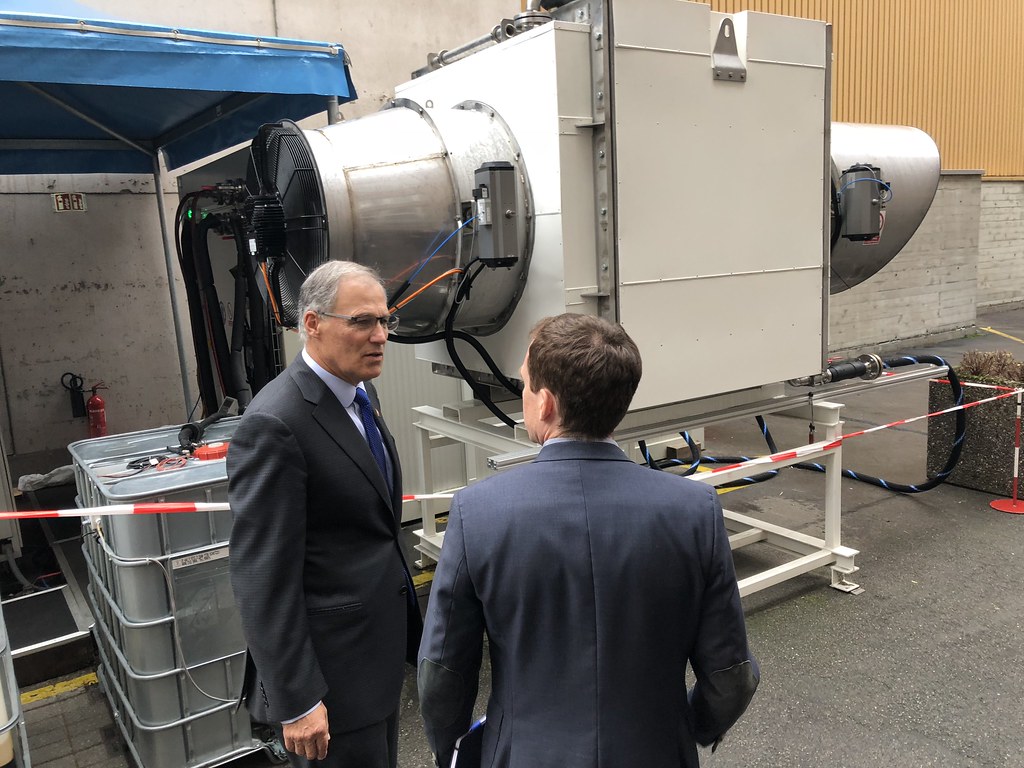


瑞士碳捕捉公司Climeworks是目前全球僅有的吸碳工廠。圖片來源: (CC BY-ND 2.0)

這些問題之間的關聯性?有哪些解決方案?

正如報告所明確指出,氣候變遷、沙漠化、土地劣化和糧食不安全都是彼此重疊的問題,這些問題也與水資源供給和生物多樣性等更廣泛的問題密切相關。

報告匯集了各方面的問題,並探討共同因應所有這些問題的方法,評估每種方案的可行性,以及因應未來氣候變遷的限制。

解決這些問題的策略包括減少食物浪費、種植更多樹木等,但每種策略都有自身的複雜度,通常有些必須考慮的副作用。此外還有重大的地域性差異,許多作法需要時間才能發揮效果。

報告也探討這種「整合性因應方案」將如何影響聯合國永續發展目標(SDGs)以及生物多樣性和生態系統服務政府間平台(IPBES)提出的自然對人類的貢獻概念(NCP)──總共討論了40個具體方案。其中8個方案為報告中談到的各種土地議題提供中到高度的利益,分別是提高糧食生產率、改善森林管理、減少砍伐森林、增加土壤有機碳含量、增強礦物風化、飲食習慣改變、減少收穫損失、減少食物浪費。

作者發現,大多數因應方案可在不競爭可用土地的情況下實施,包括改善作物管理和增加土壤碳含量。其他方法,如飲食習慣改變和減少食物浪費則可以釋出土地。整體而言,其中17個方案對SDGs或NCP沒有任何副作用。

確立了不同解決方案的潛力後,報告繼續討論實施這些方案需要作出的政策決定。表7.5詳列可因應氣候變遷和土地各個彼此關聯的問題的政策、計畫和工具。

第六章列出土地利用的各種需要取捨之處後,作者認為,全球目前氣候政策和決策未能考量這些取捨。例如,作者注意到水力發電設施可能妨礙魚類活動,太陽能和風力發電場可能會影響瀕危物種並破壞棲息地。

其中浮現出的一個關鍵訊息是「只有將農業排放納入主流氣候政策,才能實現本報告中評估的所有減緩潛力」。報告的結論是,碳定價有機會透過市場或稅收減少溫室氣體排放,但報告也提醒,該產業的效果仍然相對缺少實證。

目前以土地為基礎的策略佔巴黎協定國家自主減排承諾總量的四分之一,許多方案已經在實施中。

SPM指出,許多策略在轉化為政策之前需要考慮當地的環境和社會經濟問題:「土壤碳管理等部分方法可能適用大多數土地利用類型,而有機土壤、泥炭地和濕地以及與淡水資源相關的土地管理實踐的效果取決於當地農業生態條件。」

淨零土地劣化是一個能帶來巨大利益但也深具挑戰性的目標,取決於「在地方、區域和國家層級,跨領域整合多種解決方案,包括農業、牧場、森林和水資源。

報告的結論是,一系列連貫的氣候和土地政策可推進巴黎協定目標和永續發展目標中的土地相關目標,並指出越早嚴肅採取行動越好。

然而,某些策略,如BECCS,距離大規模實作還有很長的路要走,而另一些則面臨重大的「政策遲滯」:「連部分一開始看起來能輕鬆達成的行動也窒礙難行,政策停滯不前就是個血淋淋的例子,說明這些解決方案非常需要足夠的資金、機構和地方的支持以及明確的成功指標。」


東加里曼丹空照圖,呈現被開墾成棕櫚園的雨林。 (CC BY-SA 2.0)

報告對永續發展、性別和原民社區的作用有何評論?

和1.5°C報告類似,土地報告非常強調因應氣候變遷與確保永續發展之間的相關。

報告的最後一章(第七章)專門討論因應氣候變遷的土地決策與永續發展的關係,指出氣候變遷和土地利用尤其威脅著全世界的窮人。

SPM表示,未來的土地相關氣候變遷政策需要經過精心設計,以盡量避免讓貧困人口面臨風險,「由於問題的複雜程度和參與解決土地問題的角色多元,達成永續土地管理和因應氣候變遷需要一整套而非單一政策,方可取得更好的成果。」

這反映了報告第六章,土地負碳排方法可能產生的影響。這章說,僅採用單一大規模負碳排技術可能會為人和野生動植物帶來重大風險。而且某些大規模土地負碳排,包括生物能源或BECCS,可能會與聯合國的部分永續發展目標衝突。如目標15,其目的是「保護、恢復和促進陸域生態系的永續利用,永續管理森林,防治沙漠化,抑制和扭轉土地劣化和生物多樣性喪失」。

有些土地負碳排技術可在減碳的同時為這個目標創造共同利益,包括避免砍伐森林、提高糧食生產力和增加土壤碳儲量。

SPM表示,氣候變遷相關經濟政策也可以往盡可能降低世界貧困人口風險的方向設計:「這些政策的要素可能包括天氣和健康保險、社會保護和適應性安全網,應急融資和儲備基金,預警系統補助以及有效的應變計畫。」

而在採取永續土地的氣候變遷解決方案方面,報告強調在其中進一步提升性別平等的重要性。第七章第87頁的註解如下:「性別是社會不平等的一項關鍵,與其他權力和邊緣化系統交會 ──包括種族、文化、階級/社會經濟地位、地理位置、性別和年齡 ,這導致氣候變遷韌性和適應能力的不平等。」

在農村地區,女性比男性更容易受到氣候變遷及土地解決方案的影響,只是方式不同。

例如,研究發現,在澳洲和加拿大的農場,調適氣候變遷的工作不成比例地落在女性頭上。在衣索比亞的研究則發現,戶長是男性的家庭,可以獲得比戶長是女性的家庭更多的調適措施。

第七章說,未來的氣候政策應該更充分意識到性別平等的需求。可以透過制定增強女性財務授權和土地所有權的政策來實現。


幾內亞農村的勞動女性。來源:聯合國婦女計畫,Joe Saade攝(CC BY-NC-ND 2.0)

在整個報告中,多處提及當地知識(來自本土社群的知識)納入土地決策的重要性。

報告指出,缺乏長期紀錄資料時,原民知識能在理解氣候變遷對地區土地的影響上發揮關鍵作用。SPM提到,「根據原民和當地知識,氣候變遷正在影響乾旱地區的糧食安全,尤其是非洲、亞洲和南美洲的高山地區。」

聯合國原民權利問題特別報告員塔里寇培茲(Victoria Tauli-Corpuz)表示,原民參與解決方案制定是很重要的。他在報告發布前的記者會上說:「沒有人比原民和當地社群更了解糧食、燃料和森林之間的衝突。我們經常處於土地衝突的十字路口,尤其是森林。身為專家,我們常以數百年來累積的知識為指引,非常適合管理、保護和恢復世界森林。」
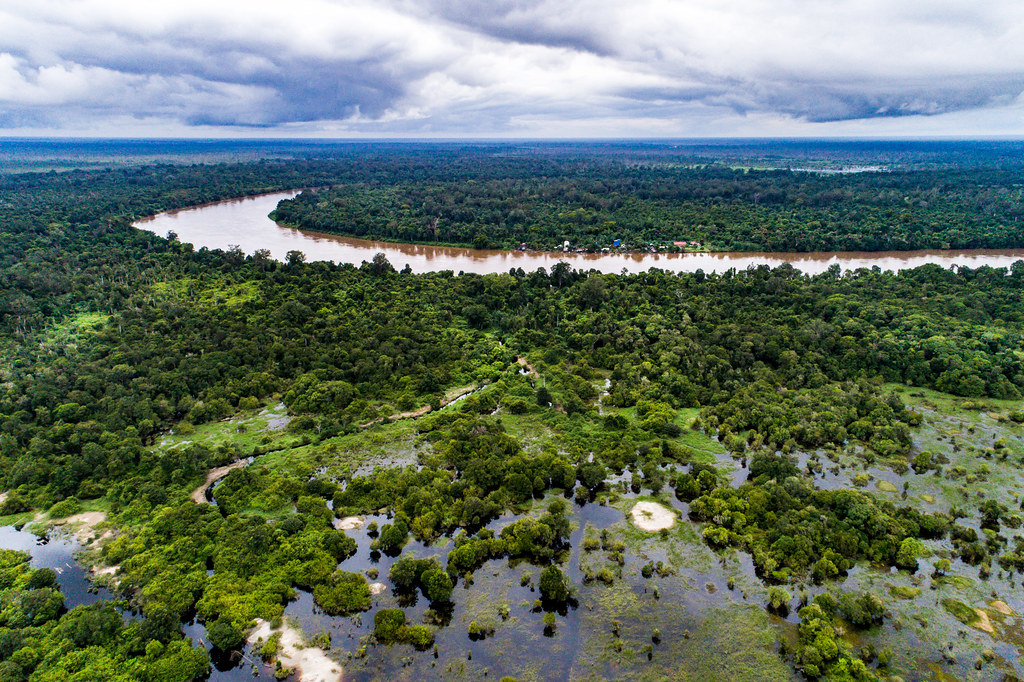


加里曼丹中部雨林的泥炭地。 (CC BY-NC-ND 2.0)

目前為止有哪些回饋?

IPCC土地特別報告引起全球媒體大幅報導。最初的新聞報導聚焦在多重風險相互交疊的性質。如,報告指出氣候危機正在破壞土地供養人類的能力,隨著全球氣溫上升,連續風險變得越來越嚴重。,報告探討了全球暖化和土地如何地惡性循環。人為造成的氣候變遷正在大幅度劣化土地,人們使用土地的方式也正在加劇全球暖化。衛報的文章警告氣候變遷對土地的影響「威脅人類文明」。

糧食和飲食習慣也是報導焦點。,「氣候變遷對糧食、水和土地造成的損失比我們所知更嚴重。報導,如果採取正確的農法,可以餵飽全球同時因應氣候變遷 。頭條新聞稱「氣候變遷威脅世界糧食供給。,轉向以植物為基礎的飲食有助於因應氣候變遷。標題寫道:「聯合國呼籲,少吃肉,救地球」,後續報導指出,減少食物浪費和少吃肉可以避免大片土地因農業而劣化,減少氣候變遷。

另一方面,:「人類必須徹底改變糧食生產方式,以防止全球暖化造成災難。」,「農業和飲食習慣必須改變,以遏制全球暖化。」和亦有類似報導。

英國下標:「氣候報告警告陸地氣溫升高」,並指出陸地空氣暖化速度大約是全球平均的兩倍。

首波媒體報導後,許多非政府組織陸續發表對IPCC報告的回應。

世界自然基金會(WWF)氣候變遷首席顧問兼IPCC負責人科尼利厄斯(Stephen Cornelius):「報告明確地表示,我們目前使用土地的方式正在助長氣候變遷,同時削弱了土地支持人與自然的能力。」「我們需要立即改變使用土地的方式。優先工作包括保護和恢復自然生態系,以及實現永續糧食生產和消費。」

氣候行動網(CAN)歐洲主任特里歐(Wendel Trio)提醒:「從報告可看出,若以升溫1.5°C為目標,就必須採取行動以避免破壞糧食鏈。」「頻繁的乾旱、洪水、熱浪和野火,讓許多歐洲農民減產和收入減少。其中有些人已經撐不下去。」

有些非政府組織強調報告中關於利用土地吸收和儲存碳的內容。英國皇家鳥會(RSPB)保育主任哈潑(Martin Harper)說:「不僅是恢復世界自然財富的機會,還有助於抑制氣候變遷。」

有些非政府組織特別關注土地需求衝突的平衡。基督教救助協會(Christian Aid)全球氣候主任克萊摩(Katherine Kramer)博士說:「報告呼籲我們為人類、自然和氣候更妥善地管理土地。在土地利用方式上創造雙贏的方法很多,但我們必須盡快行動,以避免在餵飽人口和減少排放之間取捨。」

其他非政府組織對報告中負碳排技術內容的評論更為直白。 ActionAid的氣候政策協調員安德森(Teresa Anderson)說:「報告發出了嚴肅的警吿-依賴生物能源、碳捕獲和儲存等危險技術,將佔用大量土地,與我們改善糧食安全和保護自然生態系統的需求背道而馳。」「富裕的污染國不能指望南營放棄大片農田來解決氣候問題。」

CAN生態系統協調員普特(Peg Putt)說BECCS是「生態系統、人類和糧食安全的重大威脅」,「我們顯然無法承受失去或破壞重要生態系統的代價,該報告明確指出大規模開發生物能源和BECCS是不能接受也不可行的。」

350.org研究和募款協調員伊格斯(Mahir Ilgaz)也警告,「錯誤的解決方案將帶給生病的土地和生物多樣性更大的壓力」。「我們需要尋求不迫使人們離開自己土地的選項,也不能用生物多樣性換取更多的單一化栽培和工業化農業。」

保育機構的生物能源活動負責人路德馬(Linde Zuidema)表示,該報告「呼籲政府逐步淘汰導致森林砍伐和森林劣化的有害補貼」,「這表示歐盟應該逐步取消對生物能源的補貼,轉而關注促進森林的保護和復育,這已經證實有益於自然和人類。」

Drax集團執行長加迪納(Will Gardiner)則認為,「BECCS是因應全球氣候緊急情況的必要技術」,該集團已逐步將其位於Drax的燃煤發電站改為燃燒木屑顆粒。

部分科學機構及其主要研究人員也發表聲明回應報告。波茨坦氣候影響研究所(PIK)主任洛克斯壯(Johan Rockström)教授說:「IPCC土地報告證實,我們正面臨全球性的緊急情況,能採取重要行動的時間越來越短,無所作為的代價將是災難。雖然報告描述了可能的淒慘後果,但也指明了前進的方向,包括立即採取行動的機會。」

全球公共與氣候變化墨卡托研究所福斯(Sabine Fuss)教授警告,「如果農業(佔所有溫室氣體排放量的五分之一)無法快速變革,可能會導致嚴重的土地使用競爭。」「到時就必須大規模地從大氣中去除碳,以造林或生物能源的方式,這可能就得犧牲糧食供給或生物多樣性。」

里茲大學(University of Leeds)氣候變遷福斯特(Piers Forster)教授也提出類似觀點,「為了將升溫限制在1.5°C以下,我們需要大幅改變使用土地的方式……簡言之,我們需要更少的牧場、更多的樹木,實際上這表示我們更加仔細地考慮如何使用每英畝的土地。土地要用來種植糧食,提供生物多樣性和淡水,為數十億人提供工作,並吸收數十億噸碳。」

東英吉利大學皇家學會氣候變遷科學教授、英國氣候變遷委員會(CCC)成員拉奎爾(Corinne Le Quéré)教授表示,「IPCC的調查結果與CCC給政府的建議一致,英國需要減少食物浪費、鼓勵健康飲食,並永續地使用土地,包括種植更多的樹木和復育劣化的土壤。所有這些方法都將有助改善人們的生活,同時減少導致氣候變遷的有害排放。」(系列專文3/3,完)

In-depth Q&A: The IPCC’s special report on climate change and land (3/3) by Carbon Brief

How could ‘negative emissions’ affect land, food and wildlife?

A major finding of the IPCC’s landmark was that some degree of “negative emissions” will be needed to keep global warming within “safe limits”.

“” are a group of methods that aim to remove CO2 from the atmosphere and store it in the land or ocean. They range from the – planting trees, for example – to the technologically advanced, such as using machines to suck CO2 from the air (known as , or DAC).

If pursued at scale, most of these techniques would require varying amounts of land – potentially reducing the land left for wildlife and food production.

The land report emphasises that there is no one “” when it comes to negative emissions and that, if just one technique were deployed on a vast scale, it could “increase risks for , land degradation, food security and sustainable development”.

Many of the modelled pathways for limiting global warming to 1.5C rely heavily on a technique called “bioenergy with carbon capture and storage” (). ( has suggested the 1.5C target can be achieved without BECCS, but only under stretching assumptions for change elsewhere.)

This technique involves growing crops, using them to produce energy and then capturing the resulting CO2 emissions before storing them in the ground or sea. A small number of carry out BECCS – but the technique has not yet been proven to work at scale.

How much BECCS is used in the future will depend on a range of complex social and technical factors, the report says. (To read more about the world’s possible future socioeconomic pathways, please see: “”)

However, if BECCS is pursued at the level “necessary to remove CO2 from the atmosphere at the scale of several billion tonnes of CO2 per year”, it could “increase pressure on land” and cause “land degradation”, the report says.

Widespread tree planting – also known as “” – could also come with risks, the SPM says. Large-scale afforestation could “increase demand for land conversion” and raise risks of degradation, the report says.


The graphic below, taken from the SPM, gives an overview of the various impacts of different options for removing CO2 from the atmosphere.

For each technique, the graphic gives an idea of its ability to remove CO2 from the atmosphere (“mitigation”; first column); to help people adapt to climate change (“adaptation”; second column); to avoid desertification (third column); to avoid land degradation (fourth column) and to aid food security (fifth column).

Light to dark turquoise illustrate that the technique has a positive impact in these areas, whereas light to dark red represent a negative impact. (More detail on the scale of impacts is offered in the key.)

The potential cost of implementing the technique is shown with dots on the far right-hand side. Letters represent the level of confidence in the findings (with “L” representing low, “M” representing medium and “H” representing high).

A graphic giving an overview of the potential impacts of various techniques for removing CO2 from the atmosphere. Light to dark turquoise illustrate that the technique has a positive impact in these areas, whereas light to dark red represent a negative impact. The potential cost of implementing the technique is shown with dots on the far right-hand side. Letters represent the level of confidence in the findings (with “L” representing low, “M” representing medium and “H” representing high). Source: Adapted from SPM.3A of the .

A second figure in the SPM compares the risks of potentially global techniques such as BECCS (top) and afforestation (bottom). This figure shows the risks if the techniques are used at a “high level” versus if they are used at “best practice”. This figure makes use of the same colour scale as the previous figure but also uses green to signify potential co-benefits.

Comparison of the risks of bioenergy and BECCS and afforestation when implemented at a “high level” versus at “best practice”. Dark turquoise illustrates that the technique has a positive impact in these areas, whereas light to dark red represents a negative impact. Green signifies the possibility of co-benefits for each area. The potential cost of implementing the technique is shown with dots on the far right-hand side. Letters represent the level of confidence in the findings (with “L” representing low, “M” representing medium and “H” representing high). Source: Adapted from SPM.3B of the .

The figure shows that both “high level” BECCS and afforestation could come with high risks for food security. The figure also shows, however, that risks to climate change adaptation, desertification and land degradation could be higher with “high level” BECCS than with “high level” afforestation.

If deployed on smaller scales and with “best practice”, however, both options could remove CO2 from the atmosphere while providing “co-benefits” for people and wildlife, the SPM says:

“Applied on a limited share of total land, land-based mitigation measures that displace other land uses have fewer adverse side-effects and can have positive co-benefits for adaptation, desertification, land degradation or food security.”

For both techniques, it is not just the scale of land used that will be important, but also the way in which they are carried out, says , lead author of of the land report and a lead researcher of environmental change from the . She tells a press conference for UK journalists:

“Many of these options can be sustainable depending on the way that we do them. And, if they are done in an integrated sustainable way they could have many co-benefits. However, if they are done on very, very large areas of land and with monocultures, and on areas of land that are already sensitive to desertification, that could have greater impacts.

“The more area of land that is taken, the more risks there are for food security. But it’s not just about the scale, it is also about the way in which we do things. That’s the really important message: we could do things well or we could do things in a way that increases risks.”

There are also several techniques that could, according to the report, remove large quantities of CO2 from the atmosphere while enhancing food security and protecting against degradation.

These include reducing current levels of deforestation and forest degradation and boosting the carbon stores of soils.

Many options exist within agriculture to remove large quantities of CO2 while providing co-benefits for the land, the graphic shows. Such techniques, including increasing food productivity, and improving the management of crops and livestock, are mentioned in more detail below under: “”

The report emphasises that pursuing an “integrated approach” – involving many different land-based negative emissions techniques, could deliver large CO2 removal while minimising risks to people and wildlife.

However, many options for CO2 removal still face large “economic, technological, institutional, socio-cultural, environmental and geophysical barriers”, the report says.

If delays to deployment continue, the overall ability of land-based negative emissions to remove CO2 from the atmosphere could start to decrease, says :

“The potential for some land management options decreases as climate change increases; for example, climate alters the sink capacity for soil and vegetation carbon sequestration, reducing the potential for increased soil organic carbon.”

How are the issues linked and what solutions exist?

As the report makes clear, climate change, , land degradation and food insecurity are all overlapping challenges that also tie into wider concerns such as water availability and biodiversity.

of the report draws together the various strands, and considers ways to deal with all of these challenges together. The feasibility of each option is assessed, as well as its vulnerability to future climate change.

Strategies to address these issues range from cutting food waste to planting more trees, but each one comes with its own complications, the report notes, often including adverse side-effects that must be taken into consideration. There are also significant regional differences, and the authors note that many of the responses will take time to be effective.

It also considers how such “integrated response options” would affect the UN’s (SDGs) and the concept of (NCP) laid out by the (IPBES).

In total, the report considers 40 specific responses to the issues. Eight of these options yielded medium to large benefits for all of the land challenges being considered: increased food productivity; improved forest management; reduced deforestation; increased soil organic carbon content; enhanced mineral weathering; dietary changes; reduced post-harvest losses; and .

The authors found that “most response options” can be implemented without competing for available land, including improvements to crop management and increasing the carbon content of soils. Others, such as dietary changes and cuts to food waste will actively free up land.

It also finds that, overall, 17 of the strategies could be delivered with no adverse side effects for either SDGs or NCPs.

Having established the potential of different responses to the challenges the planet faces, in of the report, it goes on to consider the policy decisions that would need to be made to implement them.

Table 7.5 details policies, programmes and instruments that could be implemented to deal with each of the interlocking issues around climate change and land.

After identifying the various trade-offs in land use in , they acknowledge that for the most part globally “trade-offs currently do not figure into climate policies and decision making”. By way of example, they note that hydropower installations the movements of fish, and solar and wind farms can affect endangered species and disrupt habitats.

One key message emerging is that “the full mitigation potential assessed in this report will only be realised if agricultural emissions are included in mainstream climate policy”. The report concludes that carbon pricing, through markets or taxation, has the potential to cut greenhouse gas emissions while noting it is still relatively untested in this sector.

Many measures are already being implemented, with land-based strategies currently covering up to a quarter of the total mitigation proposed by nations’ submitted under the Paris Agreement.

The SPM notes that many strategies will require consideration of local environmental and socioeconomic issues before being translated into policy:

“Some options such as soil carbon management are potentially applicable across a broad range of land use types, whereas the efficacy of land management practices relating to organic soils, peatlands and wetlands, and those linked to freshwater resources, depends on specific agro-ecological conditions.”

Land degradation neutrality [see on desertification for more on this], is a target with huge benefits but also a major challenge, and one the report says depends on the “integration of multiple responses across local, regional and national scales, multiple sectors including agriculture, pasture, forest and water”.

The report concludes that a “suite of coherent climate and land policies” would both advance the goal of the Paris Agreement and the land-related targets of the SDGs, noting that the earlier serious action is taken, the better.

However, it also points out that some strategies, such as BECCS, are a long way from being realised on a large scale, while others face significant “policy lags”:

“Even some actions that initially seemed like ‘easy wins’ have been challenging to implement, with stalled policies for providing clear examples of how response options need sufficient funding, institutional support, local buy-in, and clear metrics for success, among other necessary enabling conditions.”

What does the report say about sustainable development, gender and the role of indigenous communities?

In a similar vein to the , the land report has a heavy emphasis on the links between addressing climate change and ensuring sustainable development.

The final chapter of the report () is devoted to how land-based decisions for tackling climate change tie-in with sustainable development.

Climate change and land use particularly threaten the world’s poor, the report notes.

Future policies for tackling climate change involving the land will need to be carefully designed in order to minimise risks for those living in poverty, the SPM says:

“Due to the complexity of challenges and the diversity of actors involved in addressing land challenges, a mix of policies, rather than single policy approaches, can deliver improved results in addressing the complex challenges of sustainable land management and climate change.”

This language mirrors that of the of the report, which looks at the possible impacts of land-based “negative emissions”.

This chapter says that pursuing just one negative emissions technique on a very large scale could come with significant risks for people and wildlife.

It also notes some options for large-scale land-based CO2 removal, including bioenergy or BECCS, could come with trade-offs for several of the UN’s .

Among goals that could be negatively affected is , which aims to “protect, restore and promote sustainable use of terrestrial ecosystems, sustainably manage forests, combat desertification, and halt and reverse land degradation and halt biodiversity loss”.

However, several other land-based negative emissions techniques could remove CO2 while providing co-benefits for this goal, the report says. These include avoiding further deforestation, increasing food productivity and boosting the carbon stores of soils.

(For more information, see: “”)

Economic policies for tackling change, too, could be designed in such a way as to minimise the risks to the world’s poor, the SPM says:

“Elements of such policy mixes may include weather and health insurance, social protection and adaptive safety nets, contingent finance and reserve funds, universal access to early warning systems combined with effective contingency plans.”

The report notes the importance of attaining greater levels of gender equity in sustainable land-based solutions for tackling climate change. A box on gender on page 87 of reads:

“Gender is a key axis of social inequality that intersects with other systems of power and marginalisation – including ‘race’, culture, class/socioeconomic status, location, sexuality, and age – to cause unequal experiences of climate change vulnerability and adaptive capacity.”

On the Tristao Islands, Guinea, an agricultural cooperative tend to planted Moringa trees, supporting biodiversity and preventing soil erosion. Credit: UN Women/Joe Saade /

The report says that, in rural areas, women face higher vulnerability to climate change and its potential land-based solutions than men – “albeit through different pathways”.

For example, research has found that the need to adapt to climate change on farms in Australia and Canada falls disproportionately on women’s workloads, the report says. In Ethiopia, research found that male-headed households had access to a wider set of adaptation measures than female-headed households, it adds.

Future climate policies should recognise the need for greater gender equality, says. This could be achieved through designing policy that enhances female financial empowerment and land ownership, it says.

Throughout the report, there are many references to the importance of including local knowledge – particularly from indigenious communities – in land-based decision making.

The report notes that indigenous knowledge can play a key role in understanding the impacts of climate change on land in regions without long-term instrumental data records. The SPM says:

“Based on indigenous and local knowledge, climate change is affecting food security in drylands, particularly those in Africa, and high mountain regions of Asia and South America.”

Greater involvement of indigenous people in the solutions needed to tackle these impacts is vital, says , UN special rapporteur on the rights of indigenous peoples. During a press conference held before the report’s release, she said:

“No one knows the conflicts playing out among food, fuel and forests better than indigenous peoples and local communities. We’re often in the crosshairs of conflicts over land, especially forests. As experts, often guided by hundreds of years of knowledge, we are uniquely suited to manage, protect and restore the world’s forests.”

What has the reaction been?

There has been extensive global media coverage of the report. (See Carbon Brief’s media summary in today’s .)

Much of the initial news reports focused on the overlapping nature of risks that the report identified. The says the report warns that “the climate crisis is damaging the ability of the land to sustain humanity, with cascading risks becoming increasingly severe as global temperatures rise”. The says the “report examines how global warming and land interact in a vicious cycle. Human-caused climate change is dramatically degrading the land, while the way people use the land is making global warming worse”. A second article warns the impacts of climate change on land “threaten civilisation”.

Food and diets also featured prominently in the coverage. coverage says “climate change is taking a bigger toll on our food, water and land than we realised”, while the says the world can “feed itself [and] fight climate change if it adopts the right recipe for farming”.

Similarly, a headline says that “climate change threatens the world’s food supply”. says that according to the report, a shift to “a plant-based diet can help fight climate change”. The headline reads: “Eat less meat to save the Earth, urges UN,” with the accompanying article noting that cutting food waste and eating less meat could reduce climate change by saving large areas of land from being “degraded by farming”.

Elsewhere, begins its coverage of the IPCC findings by saying: “Humans must drastically alter food production in order to prevent the most catastrophic effects of global warming.” reports that “farming and eating need to change to curb global warming”, according to the IPCC, with the and the taking a similar line.

The bucks the trend by running its coverage under the headline: “Climate report warns of rising air over land temperatures,” noting that the air over land is warming roughly twice as fast as the global average.

With the initial wave of media coverage, numerous NGOs have released statements in response to the IPCC report.

It “sends a clear message that the way we currently use land is contributing to climate change, while also undermining its ability to support people and nature”, says Stephen Cornelius, chief advisor on climate change and IPCC lead at :

“We need to see an urgent transformation in our land use. Priorities include protecting and restoring natural ecosystems and moving to sustainable food production and consumption.”

The report “shows that ramping up action in line with the goal to keep temperature rise to 1.5C is crucial to avoid massive disruption to our food chains”, says Wendel Trio, director of :

“Already now many farmers in Europe lose their production and revenue due to frequent droughts, floods, heat waves and wildfires. Some of them cannot adapt anymore.”

A number of NGOs pick up on what the report says about using the land to absorb and store greater amounts of carbon. Martin Harper, director of conservation, says:

” offer the opportunity to not only restore the natural riches of the world but to also slam the brakes on climate change.”

A particular focus for NGOs is the need to balance competing demands for land. As ‘s global climate lead Dr Katherine Kramer puts it:

“Today’s report is a clarion call for the need for us to manage land better for people, nature and the climate. There are many opportunities to create win-wins in the ways we use the land, but it’s vital we implement these quickly to avoid having to make bleak choices between feeding people and reducing emissions.”

Other NGOs are more frank in their assessment of what the report says about negative emissions techniques. Teresa Anderson, ‘s climate policy coordinator, says:

“It sends a stark warning that relying on harmful technologies such as bioenergy with carbon capture and storage, which would take up huge amounts of land, are at odds with our need to improve food security and protect our natural ecosystems.

“Rich, polluting countries cannot expect the Global South to give away swathes of farmland to clean up the climate mess.”

And Peg Putt, ecosystems coordinator at , describes BECCS as an “enormous threat to ecosystems, people, and food security”, adding:

“As we clearly cannot afford to lose or destroy ecosystems vital to life, the report effectively paints large scale bioenergy and BECCS as completely unacceptable and unworkable.”

Mahir Ilgaz, research and grants coordinator at , also cautions that “false solutions to the climate crisis will add even more pressure to our ailing land and biodiversity systems”. Ilgaz says:

“We will need to pursue options that do not force people off their lands and do not swap biodiversity with more monocultures and industrial agriculture.”

Linde Zuidema, bioenergy campaigner at , says the report “calls on governments to phase-out harmful subsidies that drive deforestation and forest degradation”. Zuidema adds:

“This means the EU should phase out subsidies for bioenergy and focus instead on promoting protection and restoration of forests – which has proven to be positive for nature and people.”

In contrast, Will Gardiner – chief executive of the , which has gradually been converting its coal-fired to burn wood pellets – argues that the report confirms that “BECCS is an essential technology in tackling the climate emergency the world is facing”.

Some scientific institutions and their lead researchers have also put out statements in response to the report. , director of the (PIK), says:

“The IPCC report on land confirms that we are facing a planetary emergency, that the window for taking decisive action is closing fast and that the costs of inaction will be catastrophic. While the report paints a bleak picture of what could come to pass, it also points a way forward, including opportunities for immediate action.”

from the warns that “if the rapid transition in agriculture, which accounts for about a fifth of all greenhouse gas emissions, does not succeed, it may result in serious land use competition”. She adds:

“At that point, carbon will have to be removed from the atmosphere at large scale, for example through reforestation or cultivation of biomass for bioenergy, which could come at the expense of sufficient food supplies or conserving natural biodiversity.”

, professor of climate change at the , strikes a similar tone. The report “shows that to limit temperature change below 1.5C, we need to substantially change the way we use our land”, he says:

“In a nutshell we need less pasture and more trees, but really it means thinking much harder about how we use every acre of land. Land needs to grow our food, provide biodiversity and freshwater, give work to billions of people, and suck up billions of tonnes of carbon.”

And , Royal Society professor of climate change science at the and member of the UK’s (CCC) says the “IPCC’s findings chime with our [the CCC’s] “:

“The UK needs to reduce food waste, promote healthy diets, and use land sustainably, including planting more trees and restoring degraded soils. All of these steps will help to improve people’s lives whilst reducing the harmful emissions which cause climate change.”

※ 全文及圖片詳見:()

作者

如果有一件事是重要的,如果能為孩子實現一個願望,那就是人類與大自然和諧共存。

於特有生物研究保育中心服務,小鳥和棲地是主要的研究對象。是龜毛的讀者,認為龜毛是探索世界的美德。

本站聲明:網站內容來源環境資訊中心https://e-info.org.tw/,如有侵權,請聯繫我們,我們將及時處理

【精選家事打掃相關資訊】

上班沒時間,家裡總是一團亂? 

家事清潔服務公司專業打掃,還給你煥然一新的居家環境!

家事服務推薦收納達人到府服務,助你輕鬆做家事!

專業家事服務範圍有哪些?冷氣機清洗,抽油煙機清洗?不止比你想像多更多  

清洗冷氣機,洗抽油煙機,家事服務台北詳細費用收取一覽表

泰國10年來最嚴重旱災 遭水庫淹沒寺廟重見天日

摘錄自2019年8月6日自由時報泰國報導

泰國面臨近十年來最嚴重旱災,儘管6月到10月為雨季,近期卻有水庫因水位持續走低,露出原本被淹沒的佛教寺廟遺跡,吸引許多遊客及信徒前來駐足。

綜合外媒報導,該水庫位於泰國中部,容量為9.6億立方公尺,按理來說,能灌溉四個省分、超過52萬公頃的農田,然而受到氣候影響,目前灌溉面積縮減至1200公頃左右。該寺廟過去是農業社區中心,作為宗教慶典和儀式的聚會場所使用,20年前在水庫建造期間被淹沒,如今隨著乾旱露出地面,外觀只剩下斷垣殘壁,不過廟宇大致的結構依然清晰可見,其中包括被斬首的半身佛像,而周圍地區散落著至少700座房屋的遺跡。

本站聲明:網站內容來源環境資訊中心https://e-info.org.tw/,如有侵權,請聯繫我們,我們將及時處理

【搬家相關資訊指南】

台中搬家,彰化搬家,南投搬家前需注意的眉眉角角,別等搬了再說!

避免吃悶虧無故遭抬價!台中搬家公司免費估價,有契約讓您安心有保障!

評比彰化搬家公司費用,南投搬家公司費用收費行情懶人包大公開

彰化搬家費用,南投搬家費用,距離,噸數怎麼算?達人教你簡易估價知識!

東地中海能源爭奪 土耳其第2艘鑽井船開始作業

摘錄自2019年8月8日中央社報導

土耳其和賽普勒斯共和國爭奪東地中海天然資源而緊張升溫。土耳其能源部長唐梅茲7日宣布,第2艘鑽井船「兇猛號」已開始作業,且很快會派另一艘地質考船前往當地海域。「截至今天,我們鑽井深度達1710公尺,我們在這裡會進行2個半到3個月的計畫。」唐梅茲希望在鑽探達目標深度後能夠發現天然氣。

安納杜魯新聞社(Anadolu Agency)報導,安卡拉自今春以來派遣「征服者號」(Fatih)和「兇猛號」兩艘鑽井船在東地中海探勘油氣資源,藉以主張土耳其和北賽普勒斯土耳其共和國(北賽)對相關海域的資源擁有權利,卻也因此與賽普勒斯共和國(南賽)陷入爭端。

希臘和南賽政府持續反對土耳其在東地中海的活動,並且對船員發出逮捕令,此舉獲歐盟領導人支持,加入譴責安卡拉行動的行列。

土耳其「 自由日報」(Hurriyet Daily News)報導,南賽總統阿納斯塔西亞迪斯(Nicos Anastasiades)與北賽領袖阿欽席(Mustafa Akinci)9日將就如何突破已陷入僵局達兩年的和平談判進行會商。

本站聲明:網站內容來源環境資訊中心https://e-info.org.tw/,如有侵權,請聯繫我們,我們將及時處理

【精選家事打掃相關資訊】

上班沒時間,家裡總是一團亂? 

家事清潔服務公司專業打掃,還給你煥然一新的居家環境!

家事服務推薦收納達人到府服務,助你輕鬆做家事!

專業家事服務範圍有哪些?冷氣機清洗,抽油煙機清洗?不止比你想像多更多  

清洗冷氣機,洗抽油煙機,家事服務台北詳細費用收取一覽表

歐盟對棕櫚油變臉 恐與印尼大馬掀環保貿易戰

摘錄自2019年8月10日中央通訊社印尼報導

歐洲聯盟對抗氣候變遷迫在眉睫,將限制使用棕櫚油所製成的生質燃料,而受到影響的印尼及馬來西亞棕櫚油產業今年開始回擊,讓這場環保貿易戰煙哨味愈來愈濃。

歐洲議會2017年要求歐盟限制使用棕櫚油所製成的生質燃料,並確保進入歐盟的油品符合永續標準;歐盟執委會2018年通過2030年將逐漸停止使用棕櫚油,在此情況下,將使得棕櫚油被排除在歐盟汽車可使用的生質燃料項目。

歐盟此舉引發主要生產國印尼與馬來西亞抗議,認為是貿易歧視。今年馬來西亞及印尼政府開始回擊,3月大馬首相馬哈地(Mahathir Mohamad)抨擊歐盟,表示這可能開啟大馬與歐盟之間的貿易戰。4月印尼和馬來西亞政府向歐盟遞交聯名信,反對歐盟逐步停止棕櫚油作為可再生能源計畫。馬來西亞官員7月時表示,將與印尼合作向世界貿易組織(WTO)提出申訴;8月印尼釋出將調高對歐盟乳製品的進口關稅,作為對限制棕櫚油的報復訊息。

雖然歐盟將淘汰棕櫚油作為生質燃料使用,其用意也可能是要全力扶植電動車產業,但以對抗氣候變遷與另一國發生貿易摩擦,這場棕櫚油之戰顯得相當特別。

本站聲明:網站內容來源環境資訊中心https://e-info.org.tw/,如有侵權,請聯繫我們,我們將及時處理

【搬家相關資訊指南】

在找尋搬家公司嗎?

桃園搬家公司推薦優質、合法立案,讓你安心絕不亂加價!

桃園市搬家公司協助各大專院校學生返鄉打包,詳細優惠專案請洽詢…

搬家前必知的8 件事情!價格、費用、便宜、優質桃園搬家公司哪裡找?

竹南搬家公司頭份搬家公司行情價格一覽表!

防非洲豬瘟一年撲殺五百萬頭豬 糧農組織警示亞洲國家

摘錄自2019年8月9日法廣報導

聯合國糧農組織月9日呼籲亞洲各國做好邊境防疫工作,防止豬瘟蔓延。

糧農組織表示,一年時間當中感染豬瘟死亡的豬數量,加上出於預防而被處理掉的豬數量,總共有500萬頭,為了阻止豬瘟擴散,亞洲各國需要強化控制防疫:「由於貿易過程當中沒有預防疫苗可用,各國都必須對陸上,海洋和空中邊檢防疫進行嚴格篩查,以阻止豬瘟通過動物之間的感染或染病豬肉類產品而擴散得更廣」。

聯合國糧農組織稱,目前有柬埔寨、中國、朝鮮、寮國、蒙古國和越南六個亞洲國家出現豬瘟疫情,其中在中國,越南和蒙古國,因豬瘟而造成的損失豬數量佔據全部豬數量的10%。

本站聲明:網站內容來源環境資訊中心https://e-info.org.tw/,如有侵權,請聯繫我們,我們將及時處理

【搬家相關資訊指南】

搬家不受騙不被宰 桃園搬家公司,桃園市搬家公司公開報價讓你比價不吃虧!

竹南搬家公司,頭份搬家公司細心整理裝箱服務,大型家具搬運一次搞定!

助你輕鬆搞定搬家鳥事!